25 January
Burns Night
Every January the world raises a glass to Robert Burns. We have held a Burns Supper in Dundee every year since 1861. Here is how to join us, or host your own.
Burns Night 2027 is Monday 25 January
It’s Burns Night! Raise a glass to the Bard.
In Dundee
Burns Night at Dundee Burns Club
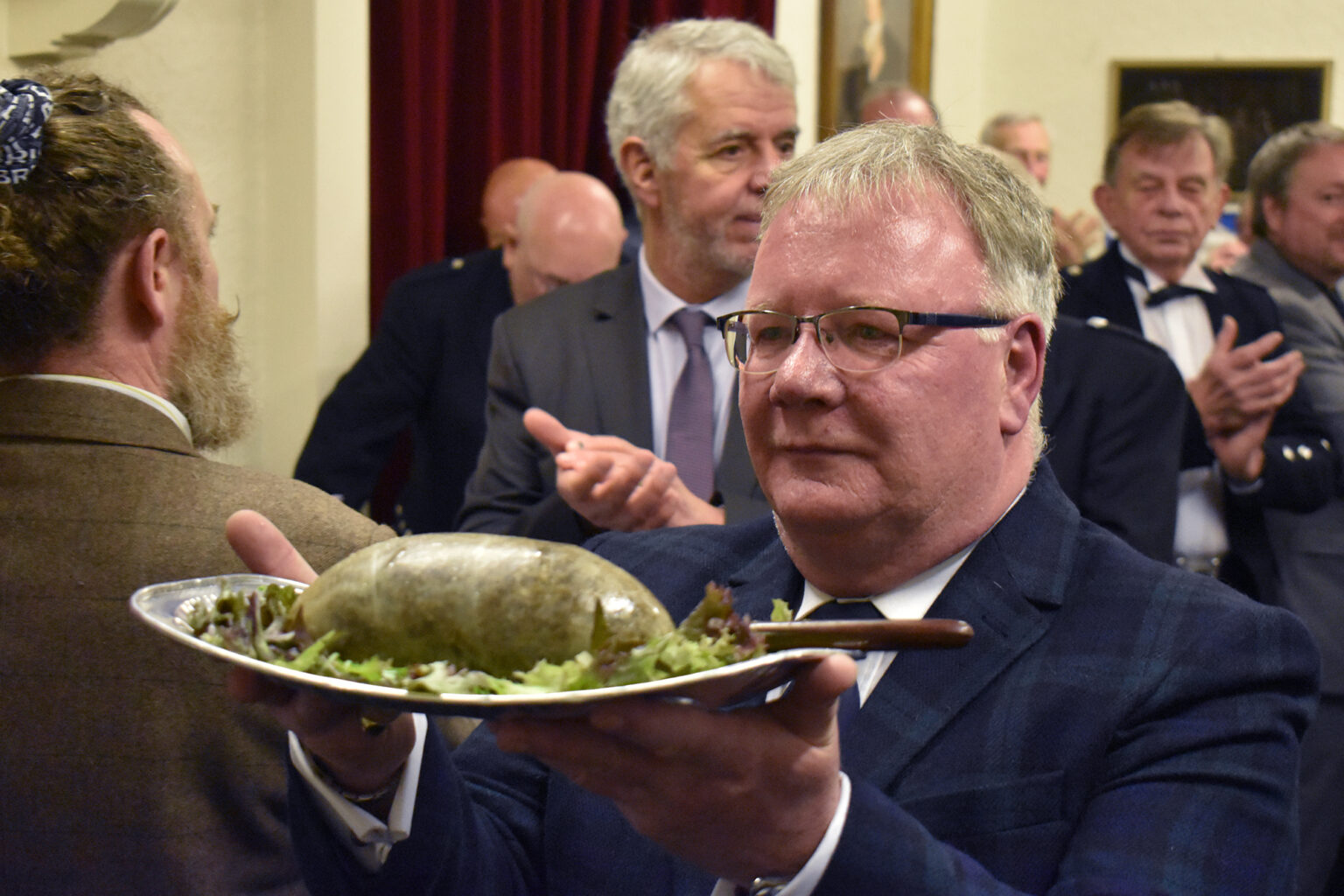
We hold two Burns Suppers each January in our historic club rooms at 37 Union Street: the Club Supper and the Open Burns Supper, a week apart. Expect the haggis piped in, the Address, an Immortal Memory, the Toast to the Lassies and the Reply, Tam o’ Shanter, songs and plenty of good company.
There are just 34 seats at each, so they go fast. Members and associates hear first and pay less.
Saturday 23 January 2027
The Club Supper
Saturday 30 January 2027
The Open Burns Supper
Members £30, non-members £35. Three-course dinner plus cheese. Book through any club member or email the Secretary.
1861
Our first Burns Supper. We have held one every year since.
34
Seats at each supper, round one long table.
2
Suppers each January, a week apart.
2026
Our first suppers with women members, raising around £2,000.
The tradition
What is Burns Night?
Burns Night celebrates the life and work of Robert Burns, Scotland’s national poet, on his birthday, 25 January. He was born in Alloway, Ayrshire, in 1759 and died in 1796, aged just 37.
On 21 July 1801, five years after his death, nine of his friends met at Burns Cottage in Alloway for a dinner in his memory. They ate haggis and sheep’s head, recited his poems and toasted their friend. They meant to meet again on his birthday, but got the date wrong and turned up on 29 January.
The idea caught on. Burns clubs sprang up across Scotland and then the world, and the Burns Supper took on the shape it still has today. Dundee Burns Club was founded in 1860 and held its first supper the following January.
Today Burns Suppers are held from Dundee to Delhi, in clubs, pubs, homes and embassies, and Auld Lang Syne, which Burns collected and wrote down, is sung around the world every New Year.
Host your own
How to run a Burns Supper
1
Welcome
The host or chair welcomes everyone and says a few words about the night ahead.
2
The Selkirk Grace
Said before the meal. It is short, so anyone can learn it.
3
Piping in the haggis
Everyone stands and claps as the haggis is carried in, ideally behind a piper. A recording works too.
4
Address to a Haggis
Burns’ poem, recited with gusto. At “An’ cut you up wi’ ready slight” the reciter slices the haggis open.
5
Toast the haggis
Raise a glass, usually a dram of whisky, to “The haggis!”
6
Supper
Haggis, neeps and tatties, often with a soup to start and cranachan to finish.
7
The Immortal Memory
The main speech, ten to twenty minutes on Burns’ life and why he still matters, ending with a toast to his memory.
8
Toast to the Lassies
Witty and warm, ending with a toast to the women in the room.
9
Reply from the Lassies
The right of reply. It usually gets the bigger laughs.
10
Songs and poems
Tam o’ Shanter, a song or two, and whatever the company has in them.
11
Vote of thanks
Thank the cook, the piper, the speakers and everyone who made the night.
12
Auld Lang Syne
Everyone stands, joins hands and sings to close the night.
The Immortal Memory
Pick one side of Burns, his songs, his politics, his loves or his link to where you live, rather than trying to cover everything. Finish by asking everyone to stand and toast “The Immortal Memory of Robert Burns”. Read one from our 2020 supper.
The Toast to the Lassies
Affectionate, funny and never cruel. Burns wrote plenty about women, so there is no shortage of lines to borrow. End with a toast “To the Lassies”, then hand over for the Reply.
No piper? No problem
A recording of the pipes, a slow handclap and a confident reciter do the job. What matters is the company, the words and a good haggis.
1786
Address to a Haggis
Tap any underlined word for its meaning in English. The reciter cuts the haggis at the third verse.
Fair fa’ your honest, sonsie face,
Great chieftain o’ the puddin-race!
Aboon them a’ ye tak your place,
Painch, tripe, or thairm:
Weel are ye wordy o’ a grace
As lang’s my arm.
Hail to the haggis, chief of all puddings, worth a grace as long as my arm.
The groaning trencher there ye fill,
Your hurdies like a distant hill,
Your pin wad help to mend a mill
In time o’ need,
While thro’ your pores the dews distil
Like amber bead.
It fills the platter like a hill, its skewer strong enough to fix a mill, its juices beading like amber.
His knife see rustic Labour dight,
An’ cut you up wi’ ready slight,
Trenching your gushing entrails bright,
Like ony ditch;
And then, O what a glorious sight,
Warm-reekin, rich!
The carver readies his knife and slices it open, steaming and rich. This is where the haggis is cut.
Then, horn for horn, they stretch an’ strive:
Deil tak the hindmost, on they drive,
Till a’ their weel-swall’d kytes belyve
Are bent like drums;
Then auld Guidman, maist like to rive,
Bethankit! hums.
Everyone tucks in, spoon after spoon, until their bellies are tight as drums and the old host sighs a grace.
Is there that owre his French ragout,
Or olio that wad staw a sow,
Or fricassee wad mak her spew
Wi’ perfect scunner,
Looks down wi’ sneering, scornfu’ view
On sic a dinner?
Would anyone sneer at this dinner, preferring fancy French food that would turn a pig’s stomach?
Poor devil! see him owre his trash,
As feckless as a wither’d rash,
His spindle shank, a guid whip-lash,
His nieve a nit;
Thro’ bloody flood or field to dash,
O how unfit!
Pity him: weak as a withered reed, legs like a whip, a fist like a nut. No use in a fight.
But mark the Rustic, haggis-fed,
The trembling earth resounds his tread.
Clap in his walie nieve a blade,
He’ll mak it whissle;
An’ legs an’ arms, an’ heads will sned,
Like taps o’ thrissle.
But the haggis-fed countryman shakes the ground as he walks. Put a sword in his hand and heads will fly like thistle tops.
Ye Pow’rs, wha mak mankind your care,
And dish them out their bill o’ fare,
Auld Scotland wants nae skinking ware
That jaups in luggies;
But, if ye wish her gratefu’ prayer,
Gie her a haggis!
Heavenly powers: Scotland wants no watery slops. If you want her thanks, give her a haggis!
Before the meal
The Selkirk Grace
Some hae meat and canna eat,
And some wad eat that want it;
But we hae meat, and we can eat,
Sae let the Lord be thankit.
Burns is said to have spoken it at a dinner given by the Earl of Selkirk, though the words are older than him.
To close the night
Auld Lang Syne
Should auld acquaintance be forgot,
And never brought to mind?
Should auld acquaintance be forgot,
And auld lang syne?
For auld lang syne, my jo,
For auld lang syne,
We’ll tak a cup o’ kindness yet,
For auld lang syne.
And there’s a hand, my trusty fiere!
And gie’s a hand o’ thine!
And we’ll tak a right gude-willie waught,
For auld lang syne.
Everyone stands in a circle holding hands. On “And there’s a hand, my trusty fiere”, cross your arms and take the hands of the people either side.
On the table
The Burns Night menu
To start
Cock-a-leekie soup, or Cullen skink, a smoked haddock chowder from the Moray coast.
The main event
Haggis, neeps and tatties: mashed turnip or swede and mashed potato. A whisky sauce is a popular extra.
For vegetarians
Vegetarian and vegan haggis is widely available and gets the same Address.
To finish
Cranachan: whipped cream, toasted oats, raspberries, honey and a splash of whisky. Or cheese and oatcakes.
To drink
A dram of Scotch whisky for the toasts. Water it as you like it.
Test yourself
How well do you know Burns?
Eight questions. Tap an answer to see if you’re right.
1. When was Robert Burns born?
Born in Alloway, Ayrshire. That is why Burns Night falls on 25 January.
2. What does Burns call the haggis?
The second line of Address to a Haggis, written in 1786.
3. Which poem gave us “the best laid schemes o’ mice an’ men”?
Written in 1785 after his plough turned up a mouse’s nest.
4. What was Burns’ day job in later life?
He joined the Excise in 1789 while still farming at Ellisland.
5. In Tam o’ Shanter, what is Tam’s horse called?
His grey mare Maggie, or Meg, loses her tail escaping the witches at the bridge.
6. Where was the first Burns Supper held, in 1801?
Nine of his friends met there five years after he died.
7. When did Burns visit Dundee?
In September 1787, on his way home from his Highland tour.
8. How old was Burns when he died?
He died in Dumfries on 21 July 1796.
Questions
Burns Night FAQs
When is Burns Night 2027?
Burns Night is on Monday 25 January 2027. Many clubs, including ours, also hold suppers on the nights around it.
Why is Burns Night on 25 January?
It is Robert Burns’ birthday. He was born in Alloway, Ayrshire, on 25 January 1759.
What do you eat on Burns Night?
Haggis, neeps (turnip or swede) and tatties (potatoes). Many suppers start with cock-a-leekie soup or Cullen skink and finish with cranachan, with a dram of whisky along the way.
Is there a vegetarian haggis?
Yes. Vegetarian and vegan haggis, made with oats, pulses, vegetables and spices, is widely sold and works just as well for the Address.
What do you say before a Burns Supper?
The Selkirk Grace: Some hae meat and canna eat, and some wad eat that want it; but we hae meat, and we can eat, sae let the Lord be thankit.
What should I wear to a Burns Supper?
A kilt or something tartan if you have it. Otherwise smart dress is fine.
Can I go to a Burns Supper in Dundee?
Yes. Dundee Burns Club holds an Open Burns Supper in its club rooms on Union Street every January. Seats are limited to 34, and members hear first.
More Burns in Dundee
Follow in the poet’s footsteps around the city, read about his life, or help keep our 166-year-old club going.